Your AI coding agent, finally explained.
My Buildy sits beside your terminal, watches what your AI coding agent just did, and tells you in plain English what happened and what to type next.
Free, open source, and it runs on your own computer.
Windows and macOS will warn you on first run — the installers aren't signed yet. We'll show you what to click.
v0.1.0 · Windows 110 MB · Mac 128 MB
Free forever · Windows 10 and 11 · macOS 14 and later · You bring your own AI key


- Open source, MIT
- Your key, your model
- Memory stays on your machine
- No account, no subscription




Who is Buildy?
Buildy is a small orange robot who sits on top of your screen and watches one window: the terminal where your AI coding agent is working.
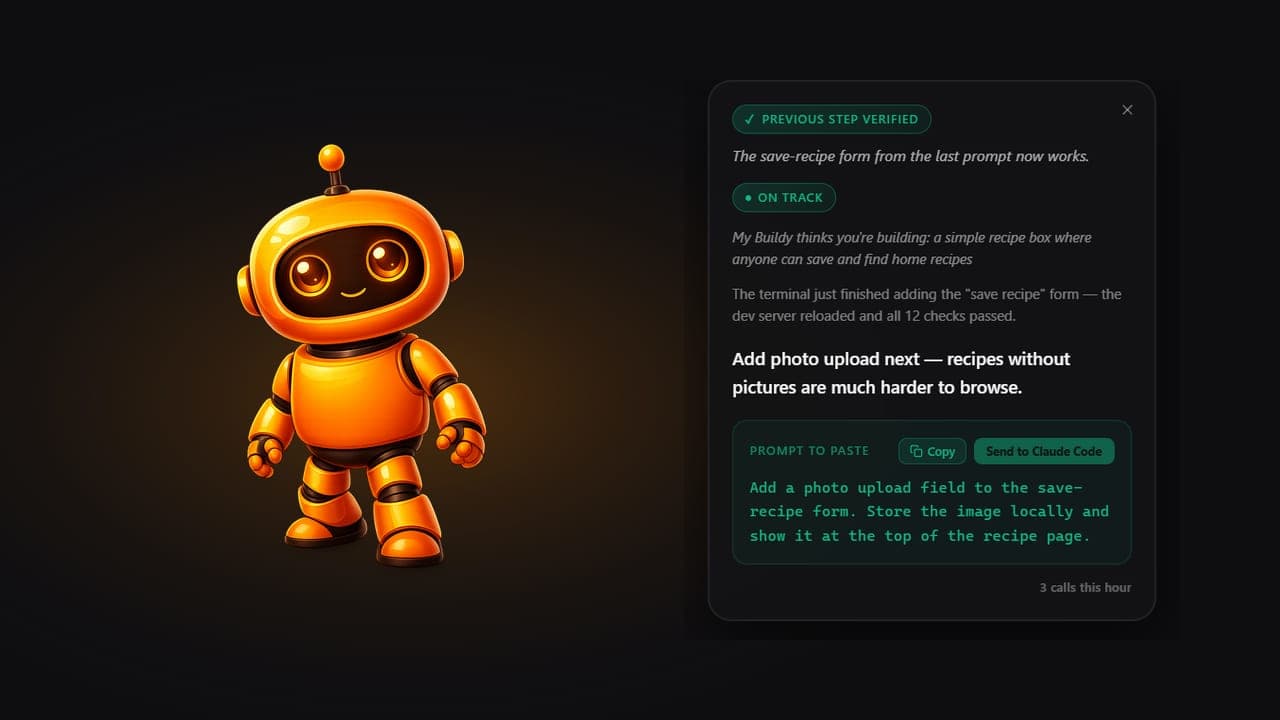
He reads what just happened and says it back to you in plain English. He tells you whether you are still heading toward what you asked for. He writes the next prompt for you, and sends it when you click.
When the agent finishes something, he checks whether it actually worked. When a decision needs a human, he stops and asks you instead of guessing.
He remembers your project between sessions, so tomorrow he knows what you built today.
Why I built this
I teach AI to people who don’t code.
In workshop after workshop I watched the same moment happen. They would build something real in an app and feel unstoppable. Then I would show them a coding agent in a terminal, because that is where the actual power is — your own files, your own project, your own machine. And they would stop.
Not because it was too hard. Because the terminal tells you what happened in a language they cannot read. In an app, something appears and you know it worked. In a terminal, forty lines scroll past and you have no idea whether you just shipped a feature or broke everything. The cursor blinks. Nobody types anything.
Every tool built for that moment assumes you can read code. So I built the one that doesn’t.
Sukin Shetty
Solution Forge Labs, Bengaluru
Watch it work
How it works
Step 1: Tell Buildy what you are building
One sentence: what you want, and what “done” looks like.
Step 2: Point him at your terminal
Click the robot, pick the window your coding agent is running in.
Step 3: Read what just happened
Plain English every time the agent finishes a step, plus whether you are still on track.
Step 4: Send the next prompt
He writes it, you read it, one click sends it into the terminal.
What he does for you
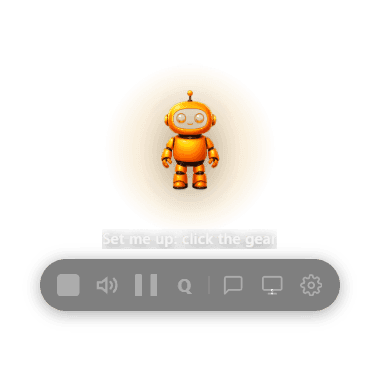
Watches your screen, not your code
You pick one window. He reads what it shows and never opens your files.
- Watches your screen, not your code. You pick one window. He reads what it shows and never opens your files.
- Plain English, every time. Every step the agent takes, explained without jargon.
- The next prompt, ready to send. He writes it, you read it, one click sends it to the terminal.
- Checks that it actually worked. When the agent says it is done, he looks for proof before moving on.
- Stops when a decision needs you. No guessing on the choices that are yours to make. He asks.
- Remembers your project. Tomorrow he knows what you built today. Stored only on your computer.
- Your key, your model. Anthropic, OpenAI, Google, OpenRouter, or a local model. You choose.
- Speaks, so you can keep reading. He can read his explanation aloud while your eyes stay on the terminal.
Works with
Coding agents
Claude Code, Codex CLI, and any coding agent that runs in a terminal.
AI providers
Anthropic, OpenAI, Google, OpenRouter, or local models through Ollama and LM Studio.
What it doesn’t do yet
- My Buildy runs the loop. You approve each step; he never sends anything on his own.
- Four of the six loop-engineering blocks are built. Scheduled runs and tool connectors are on the roadmap.
- Windows is tested most. macOS support is brand new — tell me what breaks.
- The installers are not code-signed yet, so Windows and macOS will both warn you the first time. Instructions are in the README.
Get started
Before you start, you need two things: a coding agent such as Claude Code already installed, and an API key from one AI provider.
v0.1.0 · Windows 110 MB · Mac 128 MB
- Download the installer for your computer.
- Open it. The first launch shows a warning because it is not code-signed yet; the README says what to click.
- Paste an API key from your AI provider into Settings.
- Tell Buildy what you are building, then point him at your terminal.